

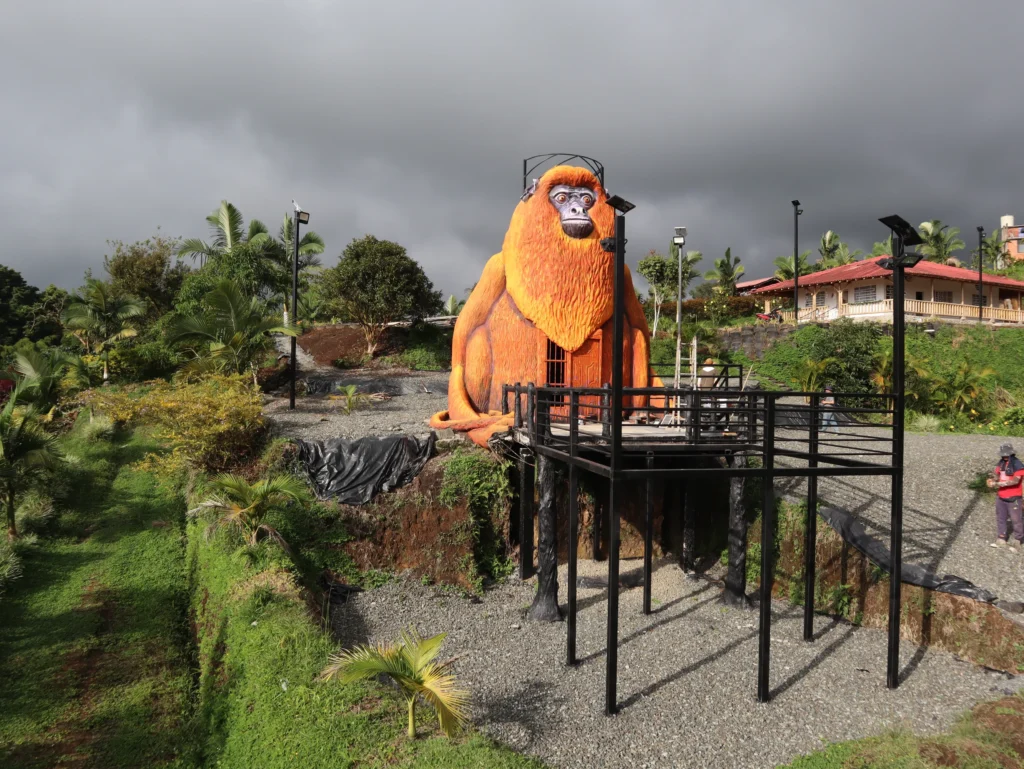
In the district of Arabia, Pereira, very close to our rental farm El Tesoro Escondido, the forest still speaks. In the living heart of the Barbas Bremen Reserve, where biodiversity is sustained in a balance as fragile as it is powerful, a sculpture emerges that has become a symbol of the territory: The Guardian of the Howl. This place has become a landmark for tourism in Arabia, Pereira, thanks to its direct connection with nature and the land.
It is a monumental howler monkey, nearly six meters tall, depicted alongside her offspring. This is no casual choice. The figure embodies motherhood, the care of life, and the continuity of the forest as a living heritage. Its presence dialogues with the landscape, the sounds of the forest, and the invisible stories that inhabit the rural areas of the Coffee Region.
Summary
The Guardian of the Howl is a monumental sculpture located in the Barbas Bremen Reserve, in Arabia, Pereira, representing a howler monkey with her offspring as a symbol of motherhood, care, and the resilience of the forest. The artwork was intervened over five days by artists Miguel Ángel Gómez, Andrés Obando, and Hugo Tangarife, who worked from a collective experience and in dialogue with the territory.
Framed within the Jardines de Resistencia project, the sculpture proposes ecological and contextual art as an ethical practice that integrates into the landscape and honors local biocultural heritage. Today, beyond its symbolic and artistic value, it has become a key attraction for tourism in Arabia, Pereira—especially for visitors interested in nature and culture, and for those seeking experiences of nature, culture, and rural rest in the district of Arabia, very close to our farm El Tesoro Escondido.
A meeting between art, territory, and tourism in Arabia, Pereira
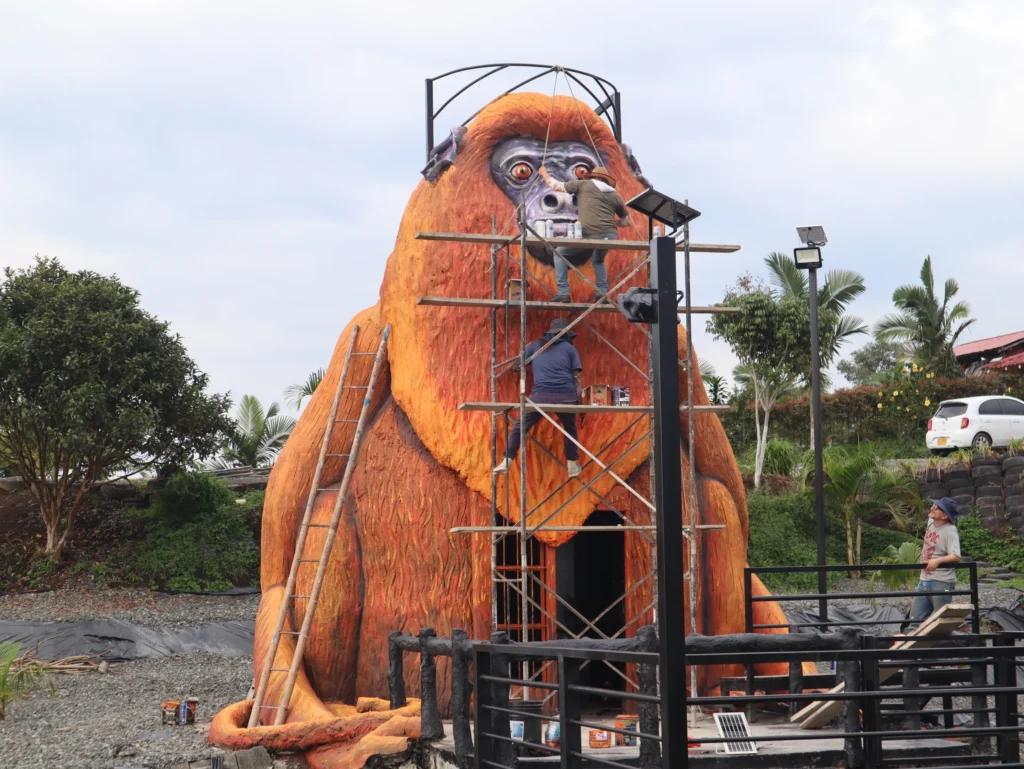
For five days, color was an act of conscious presence. Painting the sculpture was not just an aesthetic action, but an experience of deep listening to the natural environment. The artists Miguel Ángel Gómez, Andrés Obando, and Hugo Tangarife intervened in the work through a collective practice, understanding the territory as a silent teacher.
Each stroke honors the biodiversity surrounding the reserve and the biocultural heritage that intertwines nature, memory, and community. This work does not impose itself on the landscape—it is born from it and grows with it.
The howler monkey as a symbol of care and resilience
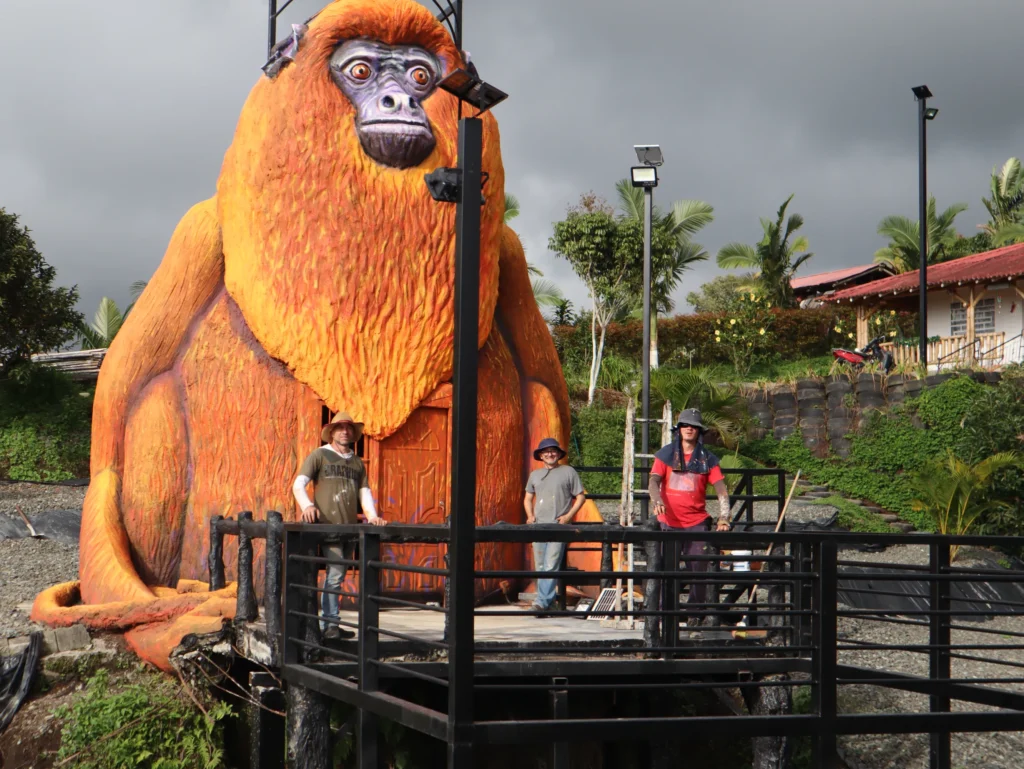
Choosing a female monkey instead of a male is a symbolic and political decision. In the feminine, care, the defense of life, and a sustaining strength without domination are represented. Her howl is not a threat—it is a call, a warning, and an ancestral song of the forest that reminds us of the fragility and power of natural balance in rural areas like Arabia.
Today, this guardian watches over the territory with the serenity of one who protects—of one who understands that to resist is also to care.
Tourism in Arabia, Pereira, and ecological art in the Barbas Bremen Reserve
This intervention is part of the project Jardines de Resistencia: Aesthetic Explorations in Rural Areas , a proposal that views art as a sensitive tool to reflect on the relationship between humans and nature.
Through ecological and contextual art, practices move from the museum to the territory and from the isolated object to the shared experience. In rural contexts like Arabia, art is not only observed—it is walked through, listened to, and inhabited.
Intervening in a sculpture within a natural reserve involves an ethical stance toward the landscape. It is not about imposing an image, but about engaging in dialogue with the species, local knowledge, and the living environment.
Tourism in Arabia, Pereira: things to do near our farm
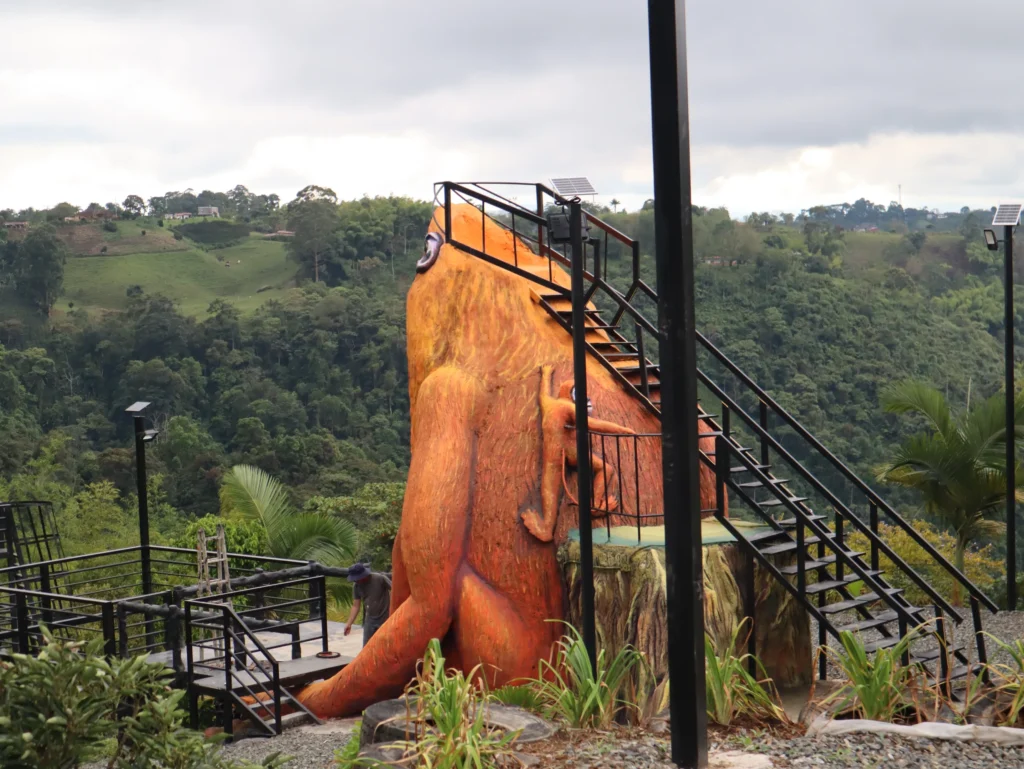
If you stay at El Tesoro Escondido, our rental farm in Arabia, this artwork is just one of the many natural and cultural points of interest you can explore in the area. We also offer rental farm options in Pereira for families and groups.
The proximity to the Barbas Bremen Reserve, the ecological trails, and the rural artistic expressions make Arabia an ideal destination for those seeking:
- Nature tourism in Pereira
- Authentic cultural experiences
- Relaxation on a private farm surrounded by forest
- Connection with the biodiversity of the Coffee Region
Living this experience is an authentic way to experience tourism in Arabia, Pereira, with respect for nature and local culture.
We invite you to learn more about our rural accommodation in Arabia, Pereira, and to enjoy an experience where rest, nature, and culture coexist in harmony.
Frequently Asked Questions
What is The Guardian of the Howl and where is it located?
It is a monumental sculpture of a howler monkey with her offspring, nearly six meters tall, located in the Barbas Bremen Reserve in the district of Arabia, Pereira. It has become a symbol of the territory because it represents motherhood, care, and the resilience of the forest, in dialogue with the landscape and the rural areas of the Coffee Region.
Who carried out the artistic intervention and what was the process?
The intervention was carried out over five days by the artists Miguel Ángel Gómez, Andrés Obando, and Hugo Tangarife. The process was conceived as an act of conscious presence and deep listening to the environment, understanding the territory as a silent teacher and honoring the local biodiversity and memory.
Why does the sculpture depict a female monkey instead of a male howler monkey?
The choice is symbolic and political. In the feminine, care, the defense of life, and a sustaining strength without domination are embodied. The guardian’s howl is not a threat, but an ancestral call that reminds us of the fragility and power of natural balance.
What does it mean that it is ecological and contextual art, and what is Jardines de Resistencia?
It means that the art integrates into the territory rather than imposing itself on it. Jardines de Resistencia is a project that understands art as a tool to reflect on the relationship between nature, memory, and community, shifting the artistic experience from the museum to the living landscape.
What can I do near El Tesoro Escondido and how can I experience mindful tourism in the area?
You can visit La Guardiana del Aullido, explore ecological trails in the Barbas Bremen Reserve, connect with rural artistic expressions, and relax in a private finca surrounded by forest. Arabia is ideal for nature and cultural tourism that respects the territory.
